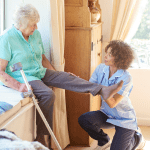
Palliative Care for People Living With Parkinson’s Disease
April is National Parkinson’s Awareness Month!
April is National Parkinson’s Awareness month and Pemi-Baker Hospice & Home Health would like to shine the light on how a palliative care team can help those living with Parkinson’s Disease.
Understanding Parkinson’s Disease
Parkinson’s disease is a progressive illness of the central nervous system that affects muscles and movement. It develops gradually, sometimes starting with a barely noticeable tremor in one hand. While hand tremors are the best-known sign of Parkinson’s disease, the disorder also causes muscle stiffness, slowing and jerking.
Parkinson’s disease is one of the most common disorders of the nervous system. It damages the system of nerves that the brain uses to tell the body’s muscles what to do. Brain activity is also affected by the loss of dopamine, an important chemical messenger that helps the neurons in the brain do their work.
Parkinson’s disease symptoms get worse as the condition progresses over time. Although the disease cannot be cured, medications can improve the symptoms. So can palliative care.
Understanding Palliative Care
Palliative (pronounced “pal-lee-uh-tiv”) care is specialized medical care for people with serious illness. It focuses on providing you with relief from the symptoms, pain and stress of a serious illness like Parkinson’s disease. The goal is to improve quality of life for both you and your family.
Palliative care is provided by a team of doctors, nurses, social workers and other specialists who work alongside your other doctors to provide an extra layer of support. It is appropriate at any age and at any stage of your illness. You can have it together with curative treatment.
Your palliative care team will help you to match your treatment choices to your personal needs and goals. That will allow you to have more control over your life. In all ways, the palliative care team helps you to better cope with the challenges of living with Parkinson’s disease.
Treating the Symptoms of Parkinson’s Disease–How Palliative Care Can Help
While there is no cure for Parkinson’s disease, there are a growing number of treatments that can provide you with relief from its symptoms. People with Parkinson’s disease are often prescribed a combination of levodopa and carbidopa, which helps replenish the brain’s shrinking supply of dopamine.
A new therapy uses electrodes surgically implanted inside the brain, and a small electrical device called a pulse generator to provide electrical deep brain stimulation (DBS). Parkinson’s patients also benefit from the expertise of physical, occupational and speech therapists to help them manage practical issues in their daily lives.
Other symptoms of Parkinson’s disease include a variety of motion-related issues, as well as sleep disturbances, fatigue (feeling weak or tired), constipation and other gastrointestinal problems, and low blood pressure.
Decisions about nutrition and feeding tubes eventually may become an issue, but the palliative care team will be able to provide guidance on this difficult subject. The social worker on your palliative care team can work closely with you to help you cope with the changes in your health. Sometimes just talking with an expert about what’s happening can be a great relief.
Another whole area of Parkinson’s symptoms is called cognitive decline, whereby ravages of the disease affect thinking and other uses of the brain. These include troubling mood disorders like depression and anxiety, unclear thinking, difficulty concentrating on a task and the potential emergence of dementia.
Some people become more disabled and dependent over time despite the best treatments. They may come to need so much help with the routine tasks of living that they require 24-hour care. This care may be provided at home or in a setting like assisted living, where they get the personal care they need.
Your palliative care team will talk with you about your hopes and preferences, and what may be possible for you to get the support you need to continue living life to the fullest. Because of the long course of Parkinson’s disease, the palliative care team can help you to clarify your goals and set up treatment plans far in advance. There are personal decisions you can make about how to live the life that remains, no matter what direction the disease takes-(Advance Care Planning).
 Your palliative care team can help you with all this and more. The team will be your sounding board and your first line of defense against any symptoms of pain, discomfort, depression or anxiety.
The team specialists will help you and your loved ones to make both large and small decisions. They will enhance communication between you, your family and your other doctors, and help you to clarify your goals for care.
How to Get Palliative Care
If you or a loved one is facing Parkinson’s disease, ask your doctor about the benefits of a palliative care team or call Pemi-Baker Hospice & Home Health for a FREE consultation to help you make sense of the situation. PBH&HH also offers free Advance Directive help, helping you fill out your forms via Zoom. We hope you call or email us today for more information.
With over 55 years of experience, serving clients from 29 towns in central and northern New Hampshire, Pemi-Baker Hospice & Home Health is committed to creating healthier communities. Services include at-home healthcare (VNA), hospice and palliative care, and Community Programs including: American Red Cross CPR/AED/FA, Caregiver Support Groups and Grief and Loss Support Groups. Providing compassionate care with experienced staff who are trained, certified professionals in the business because of their hearts. In your time of need, we’re right where you need us.
Pemi-Baker is located at 101 Boulder Point Drive, Suite 3, Plymouth, NH. To contact us please call: 603-536-2232 or email: info@pbhha.org Like our Facebook Page: @pemibakerhospicehomehealth
What do Hospice & Palliative Care Social Workers do?
 March is National Social Worker month and Pemi-Baker Hospice & Home Health wants to celebrate their social workers- Shannon Cassidy, BSW and Lauren Bell, BSW by explaining the details of Palliative and Hospice social work. The mission of hospice and palliative care social workers is to help clients and their families manage difficult situations and illnesses with dignity and peace of mind.
The Difference between Hospice and Palliative Care
While related, hospice and palliative care are distinct from each other in several key ways. Palliative care can begin at diagnosis and at the same time as treatment. Palliative care is focused on providing patients with relief from the symptoms, pain and stress of a serious illness. Palliative care also applies to patients who require non-curative remedies for painful or debilitating symptoms in their daily lives.
Hospice care begins after treatment of the disease is stopped and when it is clear that the person is not going to survive the illness. Hospice care involves caring for patients who are suffering from terminal illnesses that have progressed to the point that they have fewer than six months to live.
 What Does a Hospice or Palliative Care Social Worker Do?
The main responsibilities of Palliative and Hospice care social workers include conducting psychosocial assessments, coordinating care, providing counseling and psychotherapy, intervening in client crisis situations, and educating clients and families about their treatment plan and the resources and support systems available to them. Patients and their families are experiencing a number of hardships, including anger and anxiety; depression; financial strain; intense physical pain or discomfort; social isolation; and family conflict.
- Psychosocial assessments- Hospice and palliative care social workers conduct assessments of clients and their families to determine their psychological, social, emotional and spiritual needs. This information is important for the larger hospice and/or palliative care team to develop an effective and compassionate care plan.
- Care coordination- Hospice social workers coordinate the care of patients with a team of medical and human service professionals. With their knowledge of systems of care and support within medical settings and the larger community, hospice and palliative care social workers are often the point of contact between different care providers, as well as the liaison between clients and their treatment team. Hospice and palliative care social workers also play an important role in patient intakes and discharges. During the intake process, they gather data from patients upon their enrollment in a care program (through the psychosocial assessment), orient patients and their families to the hospice or palliative care environment and communicate with the treatment team regarding patients’ ongoing needs. They advocate on behalf of the patient and the family helping them understand their treatment plan and how to be vocal about their needs.
- Counseling- Hospice and palliative care social workers also provide emotional support, counseling and psychotherapy to clients and their families who are experiencing psychological and emotional difficulties in the face of terminal, debilitating illness or both. Social workers may employ a combination of clinical social work modalities to help their clients evaluate and manage their thoughts and emotions and overcome various behavioral challenges.
- Patient education and resource navigation services- Hospice social workers help clients and their families navigate planning for end-of-life care, educating the patient and family on filling out Advanced Directives and/or obtaining guardianship. They also help clients and their families understand their treatment plan and the processes involved in hospice and palliative care. They help families navigate relevant resources and assistance available to them connecting them with local resources, such as cancer or terminal illness support groups, pro bono counseling services and religious communities.

- Crisis intervention-Social workers help intervene in a crisis and can connect families to other support services and resources near them.
Hospice and palliative care social work is challenging work, as it involves helping people through difficult and stressful times of their lives. However, the rewards include making strong connections with people, learning and celebrating their life stories, and having a positive impact on clients and their families. “As Hospice and Palliative care social workers we strive to provide the best resources, education and assistance to clients and their families. Our primary goal is to ensure you and your loved ones are presented with options and education based on your current and long term needs to create the best possible outcome” said Lauren Bell, BSW, Pemi-Baker Hospice & Home Health’s Hospice & Palliative Care Supervisor.
If you feel you or a loved one might benefit from Pemi-Baker’s Palliative or Hospice team, please call us for more information. You do not need a referral from your doctor and there is no charge for a consultation.
Currently, Pemi-Baker Hospice & Home Health is hiring for a part time home health and hospice social worker position. Call for details or visit our page on Indeed.
With over 55 years of experience, serving clients from 29 towns in central and northern New Hampshire, Pemi-Baker Hospice & Home Health is committed to creating healthier communities. Services include at-home healthcare (VNA), hospice and palliative care, and Community Programs including: American Red Cross CPR/AED/FA, Caregiver Support Groups and Grief and Bereavement Support Groups. Providing compassionate care with experienced staff who are trained, certified professionals in the business because of their hearts. In your time of need, we’re right where you need us.
Pemi-Baker is located at 101 Boulder Point Drive, Suite 3, Plymouth, NH. To contact us please call: 603-536-2232 or email: info@pbhha.org Like our Facebook Page: @pemibakerhospicehomehealth
Why We Love National Home Health & Hospice Month

National Home Care and Hospice Month in November is when we honor all professionals who work in the broad field of home care and hospice work – this includes physicians, nurses, LNAs, social workers, physical therapists, and so many more. Each requires a different skill-set and comes with its own emotional and physical demands. The professionals who perform these services are committed to helping patients live, as well as pass away with dignity. This month is for them.
- Home Health Care Can Reduce Falls and Hospital Re-admissions
If you have had surgery or been hospitalized for a medical illness, you might have safety concerns at home, particularly the risk of falls. The truth is that falls with resulting injuries are quite common in hospitals, despite efforts to reduce them. There is a growing body of evidence to suggest that an elderly or ill person is less likely to suffer a serious event at home compared to an acute care setting. Home care can also reduce the rate of hospital re-admission.
- Home Health Care Provides a Medical Level of Care at Home
After hospitalization, most people prefer to heal at home. Similarly, the elderly prefer to stay home rather than go to a skilled nursing facility.

Home health care can provide a variety of benefits to support activities of daily living as well as 24/7 nursing care, disease management, ostomy and catheter management, surgical after care/wound care, medication management and care for high risk pregnancies, infants and children.
If the only thing keeping a patient in the hospital is the need for intravenous medications, there is good news: there is now a way to manage infusion therapy at home.
- Home Health Care Can Provide Physical Therapy and Occupational Therapy
If you’ve had surgery and you’ll be needing physical or occupational therapy, you don’t have to go to a rehabilitation facility. Pemi-Baker Hospice & Home Health offer at-home therapy services.  Another benefit that at-home therapy provides, is the opportunity to assess the safety and accessibility of the home environment. A therapist’s trained eyes can spot fall hazards or bathroom dangers and provide helpful preventive advice.
- Hospice Provides Dignity for Many
Home care and hospice workers believe that those at the end of their lives deserve the right to pass peacefully and on their own terms. The elderly often far prefer to stay in the comfort of their homes, where they feel freer and are at less risk of contracting other illnesses. The existence of hospice makes this level of freedom available to many who otherwise would not have had it. Hospice care offers 24/7 clinical support, medication and pain management, assistance with daily living activities, medical supplies and equipment, volunteer support and companionship, social, spiritual and grief support from social workers and chaplains, for the whole family.
- Hospice Month Gives us a Chance to Improve Caregivers’ Lives
These family members and/or professionals dedicate physical, emotional, and mental energy to each one of the individuals in their care, and often deal with the emotional fallout when the terminally ill take a turn for the worst or pass away. Pemi-Baker offers advice and support in the home to the families they are caring for and also offers a Caregiver Support group every first Wednesday of the month at 10:00am in person or via ZOOM.
- Hospice Proves the Healing Power of the Home and Loved Ones
 The elderly who wish to retain the freedom of staying in their home and ending their lives on their own terms experience true psychological benefits. Their comfortable surroundings allow them to end their lives with a sense of dignity, which is incredibly valuable. In fact, home care harkens back to older days, when tending to the terminally ill at home was the standard. There’s always the added benefit of being closer to their loved ones in their final days.
If you think you or your loved one would benefit from home health care, palliative care or hospice care we urge you to visit our website to learn more or call to speak directly to a professional who will guide you.
With over 50 years of experience, serving clients from 28 towns in central and northern New Hampshire, Pemi-Baker Hospice & Home Health is committed to creating healthier communities. Services include at-home healthcare (VNA), hospice and palliative care, and Community Programs including: American Red Cross CPR/AED/FA, Caregiver Support Groups and Grief and Bereavement Support Groups. Providing compassionate care with experienced staff who are trained, certified professionals in the business because of their hearts. In your time of need, we’re right where you need us.
Pemi-Baker is located at 101 Boulder Point Drive, Suite 3, Plymouth, NH. To contact us please call: 603-536-2232 or email: info@pbhha.org Like our Facebook Page: @PBCH4
~written by Anna Swanson
6th Annual Battle of the Sexes Tennis Tournament Scheduled for September 19th

Pemi-Baker Community Health (PBCH) is excited to announce that the Waterville Valley charity event, “Battle of the Sexes Tennis Tournament” will be held on the outdoor, clay courts on Sunday, September 19th 2021. Doubles men’s teams will compete against doubles women’s teams in hour long battles on the court as well as competition for overall moneys raised for PBCH’s Palliative & Hospice Care.
The generosity of our players, sponsors, and donors has raised $30,000 over the past six years for PBCH and hopes are high for bragging rights this year. You can join in the fun by registering your doubles team; players are participating from all over the state. In past years, Pirates, Roaring Twenties Flappers, Cowboys and Pink Diva costumes have added to the fun and given players point advantages. Players can also ‘buy’ mulligans / serves during play which of course adds to the proceeds and fun.
There are many other ways to get involved if you don’t want to battle it out on the tennis court. An auction site has been set up to buy raffle tickets for wine baskets, photography/artwork and more. You can also help your favorite team win the ‘Moneys Raised’ competition by donating on the auction site towards your favorite team: ‘Men’ or ‘Women’. www.32auctions.com/Battle2021
If you would rather be a spectator watching the shenanigans and banter, we encourage you to join us courtside on the 19th. Teams will be competing from 2-5pm and prizes will be given out at the after-party at the Wild Coyote Grill located in the White Mountain Athletic Club. Raffle tickets can also be bought at Pemi-Baker Community Health, courtside during the competitions and at the after-party. Many thanks to our sponsors Waterville Valley Realty and Roper Real Estate!
For more information about how you can get involved, please look on our events page.
 With over 50 years of experience, serving clients from 28 towns in central and northern New Hampshire, Pemi-Baker Community Health is committed to creating healthier communities. Services include at-home healthcare (VNA), hospice and palliative care, on-site physical and occupational therapy and aquatic therapy in their 90-degree therapy pool. Providing compassionate care with experienced staff who are trained, certified professionals in the business because of their hearts. In your time of need, we’re right where you need us.
PBCH is located at 101 Boulder Point Drive, Plymouth, NH. To contact us please call: 603-536-2232 or email: info@pbhha.org Like our Facebook Page: @PBCH4
~written by Anna Swanson
New APRN, Jill Hunter, Joins Pemi-Baker Community Health
The term Hospice Care is widely known but many times people shrug their shoulders when asked about Palliative Care. Jill Hunter, APRN, ACHPN has recently joined Pemi-Baker Community Health (PBCH) as their Nurse Practitioner in Palliative and Hospice Care. PBCH is thrilled to have her join their mission to educate Central and Northern NH about Palliative Care and how a Palliative team can help families facing serious illnesses.
Jill Hunter has been a nurse practitioner for 23 years working in primary care, both family practice and internal medicine for the Indian Health Service in New Mexico, Dartmouth Hitchcock Clinic and Concord Hospital. Most recently she has focused on palliative care, after becoming very involved with a particular patient in his late 40s, just diagnosed with renal cell carcinoma (kidney cancer). “I remained his PCP throughout his illness, managing his symptoms, coordinating with his specialists and educating his family. I celebrated his triumphs and supported him through disappointments. I eventually helped him to transition to hospice care 3 years after his initial diagnosis and remained involved in his care until he died. He taught me a lot about caring for seriously ill patients and their families. I feel that experience sparked a passion within me to become a palliative care provider,” said Hunter.
One of the biggest misunderstandings people have is thinking Palliative Care is the same as Hospice Care. Although it is a part of Hospice Care, Palliative care is specialized medical care for anyone living with a serious illness. It is appropriate at any age and at any stage of the illness, and it can be provided along with curative treatment. Pemi-Baker’s specially-trained team of doctors, nurses and other specialists work with a patient’s other doctors to provide an extra layer of support focusing on providing relief from pain, nausea, constipation, diarrhea, insomnia, anxiety, shortness of breath and other stressors of the illness.
“Most of my experiences in palliative care have been in the hospital setting. Unfortunately, the patients I see are often far along in their journey with serious illness and could have benefited from symptom management and goals of care discussions much earlier. I think that there is a growing trend of trying to introduce palliative care earlier and one of the best ways to do so is in the home—meeting patients where they are and most often where they want to remain. Working with Pemi-Baker Community Health is going to allow me to do just that,” said Hunter.
With over 50 years of experience, serving clients from 28 towns in central and northern New Hampshire, Pemi-Baker Community Health is committed to creating healthier communities. Palliative Care Services are just one of the home health services available to you through PBCH. We encourage you to talk to your doctor about getting palliative care and also encourage you to call PBCH with questions. PBCH is located at 101 Boulder Point Drive, Plymouth, NH. To contact us please call: 603-536-2232 or email: info@pbhha.org Visit our website: www.pbhha.org and like our Facebook Page: @PBCH4
Providing compassionate care with experienced staff who are trained, certified professionals
in the business because of their hearts.
In your time of need, we’re right where you need us.
~written by Anna Swanson
Dr. Kristi Saunders Joins Pemi-Baker Community Health
Pemi-Baker Community Health is excited to announce that Dr. Kristi Saunders, MD, has joined the team as their new Hospice Medical Director.
After working over twenty years in Family Medicine as a board certified OB/GYN, Dr. Saunders was drawn to palliative care and hospice by the desire to be more involved with her patients when facing serious illnesses and death. She became board certified in Hospice and Palliative Medicine in 2012 and since then has been educating her patients about living and embracing the normalcy of dying.
Working with other agencies in New Hampshire and recently receiving hospice help for her mother in California, has highlighted common challenges that families face. “My past experiences of different cultures, needs and desires made me realize how important it is to really have the time to listen, watch, and not treat everyone like medicine normally does…like everyone else. We are all different and need our care individualized. We spend too much time medicalizing death and not spending more time in what is the hard part…saying goodbye,” said Saunders. Pemi-Baker Community Health’s mission and philosophy of supporting their patients and families with compassionate care follows closely with Dr. Saunders’ beliefs. “Our goal is to educate families that hospice is really about living, not death. It should be about smiles, hugs and bringing people closer to acceptance as we possibly can,” said Saunders.
“Dr. Saunders has been serving our community as one of our hospice physicians since January and we are delighted that she will be taking over as Hospice Medical Director upon Dr. Arsenault’s retirement. Her commitment to the highest standards of client care blended with her knowledge and compassion make her an ideal fit for Pemi-Baker Community Health,” said Danielle Paquette-Horne, Senior Director of Home Health, Palliative Care & Hospice.
With over 50 years of experience, serving clients from 22 towns in central and northern New Hampshire, Pemi-Baker Community Health is committed to creating healthier communities. Services include at-home healthcare (VNA), hospice and palliative care, on-site physical and occupational therapy and aquatic therapy in their 90-degree therapy pool. Providing compassionate care with experienced staff who are trained, certified professionals in the business because of their hearts. In your time of need, we’re right where you need us.
PBCH is located at 101 Boulder Point Drive, Plymouth, NH. To contact us please call: 603-536-2232 or email: info@pbhha.org Visit our website: www.pbhha.org and like our Facebook Page: @PBCH4
~written by Anna Swanson
Dr. Diane Arsenault Retiring as Hospice Medical Director for Pemi-Baker Community Health
Please join Pemi-Baker Community Health (PBCH) in extending best wishes to Diane Arsenault, MD, FAAFP, HPM, HMDC, who is retiring as Hospice Medical Director for PBCH after 23 years of service. She will continue to serve hospice families at PBCH as well as her patients at Mid-State Health on a part time basis.
Dr. Arsenault has had an extraordinary career as a family physician, working in low risk obstetrical care for the first 20 years of her career before changing her focus to the care of the middle aged and the elderly for the last 20+ years. She felt that hospice care was just a natural extension of her role as a family physician providing care from birth to death. “Just as pregnancy and birth involve a process of anticipation, planning and intense work at the end, the end of life and process of dying have a similar journey and work. My personal experience with my father’s death in 1993 and my mother’s death in 2004, both on Hospice, allowed me to experience firsthand the joys and burden of caregiving for a dying loved one. I aspire to care for patients and families on their Hospice journey, as I and my family were supported,” said Dr. Arsenault.
When Dr. Arsenault started as Hospice Medical Director for PBCH in 1998, she had less than 10 patients at any given time. Community awareness of Hospice services and what PBCH can provide has grown over the years, increasing that number four fold. “For many years Dr. Arsenault has been the only Hospice physician in the Pemi-Baker area. Her dedication to our staff and our patients, to be available night and day, has been invaluable,” said Amy Dennis, Interim Executive Director for PBCH.
Dr. Arsenault will continue her role as Family physician at Mid-State Health Center as well as part time Hospice physician for PBCH but her schedule is now 6 weeks working then 6 weeks off. As she eases into retirement she looks forward to traveling with her husband to national parks in the Southwest, Pacific Northwest and the Canadian Maritime provinces, as well as spending as much time as possible with her 3 preschool aged grandchildren and their families.
“Our organization has grown and become stronger thanks to Dr. Arsenault’s commitment to our mission, vision and values. She has touched many lives in the process. Her kindhearted manner, undeniable professionalism and many achievements will not be forgotten. We wish her the best in the next steps of her journey,” said Danielle Paquette-Horne, Senior Director of Home Health, Palliative Care & Hospice at PBCH.
Grief and Bereavement Support Group- 6 Week Session
Pemi-Baker Community Health is pleased to resume offering its in-person community-based support group for grief and bereavement. We will be starting a 6 week series with meetings being held at the Boulder Point Conference room of Speare Memorial Hospital in Plymouth.
Because of COVID19 restrictions on social gatherings, many persons are living with unresolved and unprocessed issues of grief and loss due to abbreviated funeral or memorial services. We hope this will be a first step toward helping people come to terms with that bereavement and other issues of loss that have been neglected during the height of the pandemic.  We will be making use of GRIEF ONE DAY AT A TIME by Alan D. Wolfelt, PhD. Dr. Wolfelt is a noted grief educator, having written several books about healing personal grief. His expertise derives from his compassionate interaction and caring service with mourners, listening to and reflecting on their responses to loss. He is the Founding Director of The Center for Loss and Life Transition in Fort Collins, Colorado. Although our group is offered for support rather than clinical intervention, the use of reading materials for the purpose of self-care and personal growth and healing is sometimes called bibliotherapy. The books will be made available at our first session of the group. We ask, if possible, for group members to make a donation toward defraying the cost of purchasing the books which group members will be able to keep for themselves. No one will be turned away if they are unable to make a donation.
Grief and Bereavement Support Group (Six Week Session)
Starting: Tuesday, August 3rd, 2021- September 7th, 2021 (11:30am-1pm)
The first session of the Grief and Bereavement Group will meet on Tuesday, August 3, 2021, at 11:30am. We will meet in the Conference Room at the Boulder Point site of Speare Memorial Hospital. Participants will need to comply with checking in there. We are limiting the group to ten participants in order to allow for ample social distancing in the meeting area. Participants are also asked to have masks with them for use. At our first meeting, we will review some basic guidelines for group participation, introduce ourselves to each other, and share the nature of the loss that brought us to the group. Using Dr. Wolfelt’s book, we will look at the meditation for that day, letting that be the springboard for our discussion and interaction. To prepare for the next session, the “homework” for participants will be to read each daily meditation throughout the following week. Our discussion at each session will emerge from our responses and reactions to the week’s meditations- what we liked or did not like, what was helpful or not. The energy of the group will determine the length of the gathering, but we will conclude before 1:00pm. The Grief and Bereavement Group will meet for six sessions, concluding on September 7, 2021. After some weeks’ break, we hope to be able to begin a new Grief and Bereavement Group on October 12, 2021.
You MUST pre-register in order to participate. Please do so BEFORE WEDNESDAY, July 21, 2021. To register, please contact the facilitator,  Guy Tillson, PBCH Hospice Spiritual Counselor and Bereavement Counselor, online via email at gtillson@pbhha.org or by phone at 536-2232, XT 318. He will get back to you as promptly as possible. If you would prefer to participate virtually by ZOOM, please indicate that, and we will attempt to accommodate you. The group is limited to TEN persons, so registrations will be accepted on a “first come, first served” basis.
~written by Guy Tillson
The Chaplain? What For?
 Whenever a person is about to be admitted to hospice end-of-life care, a social worker meets with the patient, family, and other caregivers to advise them of the various supportive services that are part of hospice. One of these services is Spiritual Care, provided by the Spiritual Counselor or Chaplain. The whimsical title used above is a fairly common response to the social worker’s inquiry regarding including Spiritual Care in the treatment plan. Generally speaking, only about a third of our prospective hospice patients and the families are receptive to the visits of the Chaplain. There are a number of factors that figure into this.
First off, when people hear “Spiritual Care” they probably think “Religion” “Church” “Preaching” and “Praying”. We live in a time when these values are not well-accepted. Statistics from some years ago reported that only about 35% of New Hampshire citizens identified themselves as being affiliated with a religious denomination or formal spiritual practice. That percentage squares rather nicely and neatly with the average amount of people who respond positively for spiritual support as part of their hospice care, at least in our area. For whatever reasons, many people choose not to participate in these values that were formerly a major characteristic of our American way of life. Perhaps they had bad experiences associated with religious and spiritual practice. Perhaps they are members of recent younger generations who have never been exposed to these values, and are lacking in knowledge or awareness of what they can mean and signify in our human lives. Recent research has called this group “the Nones” meaning they check “None” on any surveys that inquire about spiritual and religious practice or affiliation.
A second factor is that, since hospice is end-of-life care, the image a Spiritual Counselor or Chaplain conjures up is that of the Angel of Death, or at least one of its minions. Persons and their caregivers have already taken a huge step in agreeing to hospice care. They are already in a mode of mourning as they prepare for the death that will occur. Perhaps declining the services of the Chaplain is perceived as a way to forestall that awesome but inevitable reality, at least for a little bit.
So, what does the Hospice Chaplain do?
The Hospice Chaplain does not interfere in the active religious practice or formal affiliation of those patients and families who subscribe to these things. If they wish to rely on their own clergy for their end-of-life spiritual care that is something hospice care encourages. If they have fallen away from their connection to their religious fellowship and wish to renew it, the Spiritual Counselor can function as a liaison in helping that to happen. In some instances, the patient may wish to have the Chaplain serve as an auxiliary to their own clergy. Hospice will do this in consultation with the clergy person involved. If the patient identifies generally with a religious tradition, but does not wish to reestablish a formal link to that tradition, the Chaplain will try to respect that tradition in his or her service to that patient and care giving system.
In my three years of service as Hospice Chaplain for Pemi-Baker Community Health, I have been able to draw upon the interfaith background of my own family heritage. Although I am most aligned with Roman Catholic, Anglican/Episcopalian, Lutheran, and Eastern Orthodox practices, I have family-related experience with Methodist, Presbyterian, Baptist, and Pentecostal beliefs and practices. I grew up in a Jewish neighborhood in New York’s mid-Hudson Valley. I have lived in metropolitan areas where religions of other cultures were present. I see ecumenical respect and reverence as a central feature in my responsibilities as the Spiritual Counselor for Pemi-Baker’s Hospice Program. I am not out to convert anyone. I do not preach at anyone. I will pray with anyone, read the Scriptures, and even sing hymns to anyone if that is their request. But I do other things, too- and a patient does not have to be religiously disposed to engage my services.
Hospice practice usually regards Spiritual Care broadly.
That can sound squishy and fluffy to some people, but since hospice is end-of-life care, a great deal of my work is facilitating what is called “life review”. What is the unique story of this person’s life? Where are they from? Where did they grow up? What did they do for work and livelihood? Whom did they love? What was important to them? What did they enjoy and find interesting? Sometimes there are deeper existential questions. “Why is this happening to me?”, “Is God punishing me?”, or “Have I lived a good life?” and “Have I done anything worthwhile?” So I listen a lot. I affirm their accomplishments. I try to soothe any regrets they may have. I celebrate the memory of their joys. If there is “unfinished business” with family members or acquaintances, I can offer to be a bridge toward resolving and healing those things.
To offer you some specific examples, there are these.
For the lady who loved gardening, I will take a book of photographs of flowers and trees and we will look at it together. I will read a book about World War II to the Naval veteran who served in the South Pacific. I will listen to classical music to the patient who loves a particular symphony or opera. I will talk recipes with the woman who likes to watch different TV cooking shows. I will read Morning Prayer for the Episcopalian who can no longer see well enough to use his prayer book. I will spend longer time with a patient whose caregiver may need some time to go out to pick up a few groceries, giving that person some often-needed respite. When a patient is actively dying, I will “sit vigil” with them regardless of whether or not they can engage in conversation with me. I think you can see that the bulk of my work is not what is usually understood as “religious” or “spiritual”.
One of my favorite memories in my service as Hospice Chaplain is about a woman who was initially suspicious about my coming to see her. Before I first met with her, her paid caregiver told me, “She mentioned when I was getting her up that “Some priest or minister is coming to see me. I’ll see what it’s like. I don’t think I’ll want him to come again.” We had a pleasant visit, mostly life review. I did not press her to pray. Somewhat surprisingly, she was willing to have me come back for companionship support. In subsequent visits, she tended to shy away whenever I tried to move toward conversation about faith and belief, so I chose to respect that. After four or five weeks of my seeing her, she had a mini-stroke, but was able to return to her home. When I saw her next, toward the end of the visit, she asked me rather matter-of-factly, “Can you say a prayer for me?” which I naturally did. It was the first opening I had in moving in the direction of assisting her with her faith, but I thought it was an isolated event. The next week, I went for my usual visit. One of her nieces was visiting with her. As the visit came to an end, I stood up to leave, but as I passed by her chair, she reached out and grabbed my forearm tightly, and asked, “No prayer?” I turned and looked at her niece and said, “The lady wants a prayer” so I knelt down right by her chair and offered a prayer.
So, if you’ve read this article, at some time in the future are ever involved in accessing hospice care for a family member (or even yourself), I hope you might pause before asking “The Chaplain? What for?” I’m rather easy to get along with. I’m caring and supportive. I’ll pray with you only if you want me to-though I’ll pray FOR you silently and quietly while I’m with you and as part of my own daily prayer routine and whenever I may think of you.
~written by Guy Tillson, Mdiv, MA, PBCH Hospice Chaplain