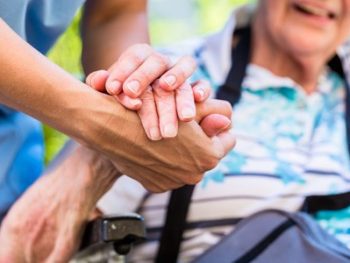
Because the holiday season can be a difficult time for persons who have endured a loss, Pemi-Baker Community Health will be offering TWO support groups in the months of November and December. These groups are open to anyone who has experienced ANY type of loss- the death of a loved one, the end of a relationship, the loss of a job, relocation to an unfamiliar area, or the passing of a beloved pet. The groups will offer an opportunity to listen and converse with others.
Both groups will be held in the Conference Room at Pemi-Baker Community Health at 101 Boulder Point in Plymouth, NH. For convenience, two times are offered: 11:00am and 5:30pm. Both groups will meet on the following dates: Tuesday, November 23 and 30, December 7, 14, 21, and 28, 2021. Because of ongoing COVID19 precautions, groups are limited to FIVE in-person participants. We will also try to accommodate virtual participants via ZOOM.
In-person participants MUST wear masks and sanitize their hands upon entering the Conference Room. There will be distanced seating. There is NO cost for attendance but you MUST pre-register by Wednesday, November 17, 2021. Registration will be on a “first come, first served” basis. To register, please contact Guy Tillson, Bereavement Coordinator, at gtillson@pbhha.org or by leaving a voicemail at (603) 536-2232. We hope that these offerings will assist those who need some support and living through “the holiday blues”.
With over 50 years of experience, serving clients from 28 towns in central and northern New Hampshire, Pemi-Baker Community Health is committed to creating healthier communities. Services include at-home healthcare (VNA), hospice and palliative care, on-site physical and occupational therapy and aquatic therapy in their 90-degree therapy pool. Providing compassionate care with experienced staff who are trained, certified professionals in the business because of their hearts. In your time of need, we’re right where you need us.
~Written by Guy Tillson, MA, MDiv, Hospice Chaplain


 With over 50 years of experience, serving clients from 28 towns in central and northern New Hampshire, Pemi-Baker Community Health is committed to creating healthier communities. Services include at-home healthcare (VNA), hospice and palliative care, on-site physical and occupational therapy and aquatic therapy in their 90-degree therapy pool. Providing compassionate care with experienced staff who are trained, certified professionals in the business because of their hearts. In your time of need, we’re right where you need us.
 Through all this, we see Alice’s progressive deterioration through the loss of her teaching career, her advancing inability to recognize those closest to her, disorientation within her own home, an interrupted suicide attempt, her husband’s decision to relocate in favor of his professional betterment, and the loving self-sacrifice of Lydia to care for her. Despite the wasting away of the many qualities that made her the person she had been, she remains “still Alice” in a brief moment of recall when she is able to identify the importance of love.
 “The Father” features Olivia Colman (currently seen as Queen Elizabeth II in Seasons Three and Four of the series “The Crown”). For her portrayal as Anne, Anthony’s daughter, Colman was nominated for the Academy Award for Best Supporting Actress.
 What to do about emerging potentially aggressive behaviors? How to live with the strain imposed on other intimate relationships? When does one arrive at the point of surrendering caregiving to a corps of providers in a setting that may better manage the patient’s needs? Hopkins’ masterful performance in this intense drama can be seen on You Tube, Amazon Prime, and Vudu.


 We will be making use of GRIEF ONE DAY AT A TIME by Alan D. Wolfelt, PhD. Dr. Wolfelt is a noted grief educator, having written several books about healing personal grief. His expertise derives from his compassionate interaction and caring service with mourners, listening to and reflecting on their responses to loss. He is the Founding Director of The Center for Loss and Life Transition in Fort Collins, Colorado. Although our group is offered for support rather than clinical intervention, the use of reading materials for the purpose of self-care and personal growth and healing is sometimes called bibliotherapy. The books will be made available at our first session of the group. We ask, if possible, for group members to make a donation toward defraying the cost of purchasing the books which group members will be able to keep for themselves. No one will be turned away if they are unable to make a donation.