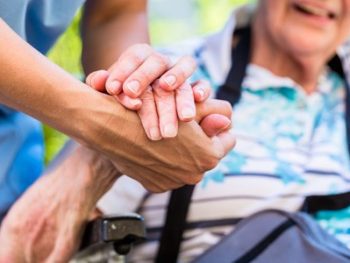
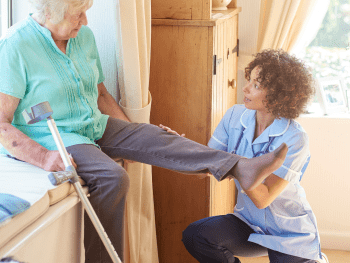
Hospice volunteers know that helping others at the end of their lives is tremendously rewarding.  Being part of a hospice team gives you the profound privilege of bringing comfort, peace and care to patients, caregivers, and their families during their transitional journey.
Volunteers feel a greater appreciation of life itself, a deeper understanding of what’s truly important, and an authentic sense of fulfillment.
Why volunteer? As a hospice volunteer, you become part of a person’s life when you are needed most. That sense of fulfillment is priceless. Also, without caring volunteers like you, there would be no Medicare-certified hospice programs. Medicare law requires that 5% of hospice care hours are provided by volunteers.
Who volunteers? People just like you. Adults, young adults, and in some cases mature teens from all backgrounds, experiences, and cultures. Effective hospice volunteers embrace the fact that their role is one of compassionate service.
What skills do I need? Most agencies like Pemi-Baker Community Health, will provide the training and orientation you need to feel confident and comfortable with whatever level of support you choose to give. Training can include things such as grief counseling, boundaries between the volunteer, the patient and the family, and emergency medical support.
Do you love music? Sharing stories? Playing cards? Whatever passions, talents, or interests you bring can also be valuable assets. The most precious asset, of course, is simply caring.
What does a hospice volunteer do? Ultimately, hospice care is about providing patients, caregivers, and families with the most comfortable and compassionate end-of-life experience possible.
Your responsibilities will vary. In many cases it’s as simple as companionship. Sitting and talking. Or just listening. Or playing a patient’s favorite music.
You may also assist patients with tasks they can no longer perform for themselves. It may include anything from light household chores to lending emotional support to the patient’s family during this difficult time.
If you prefer to work in a different capacity, some hospice providers have opportunities to help with administrative office tasks.
What is the time commitment? As with most things around hospice volunteering, your commitment can vary. It depends a lot on the time you’re willing to commit and the needs of the patients you are matched with. You can work all that out in advance when you apply.
I’m interested; how do I apply? The next free VIRTUAL Hospice Volunteer training will start Tuesday, October 6th and run 5 weeks through November 3rd. All the training is done via zoom meetings in the comfort of your own home. Contact Lauren Bell, Pemi-Baker Community Health’s Hospice Volunteer Coordinator at 603-536-2232 or email her at lbell@pbhha.org.
~Anna Swanson

 etcetera. With the ongoing pandemic, things aren’t that clean, direct, or explicit. The notion of a “new normal” brings with it the possibility that there may be some patterns of living we might not be able to recover. We are enduring a prolonged time of “not yet”. It is an experience of anticipatory grief on a global scale. It’s a hard place to be, and it may be awhile before we have any answers.

 hile promoting relaxation.
 comfortable at the end of their lives. Fewer people have heard of palliative care, and they may have no idea what it is. The truth is that
  often, board-certified in Hospice and Palliative Medicine. Additionally, the team generally includes a palliative care nurse, a social worker, a chaplain or someone who can help with spiritual support if the patient requests it, plus a patient navigator or someone who can coordinate the process. PBCH and NANA work collaboratively with


 Home health care is becoming a new front in the national fight against COVID-19 as hospitals discharge patients home and others strive to stay out of them. The