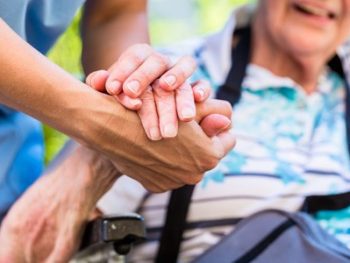
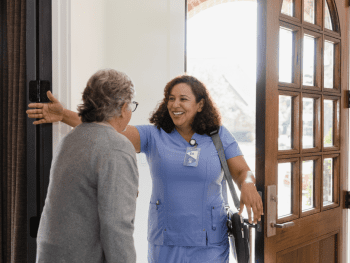
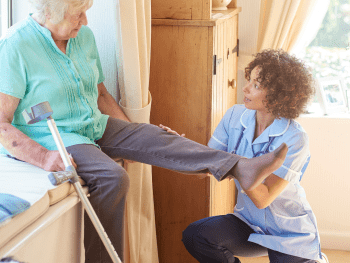
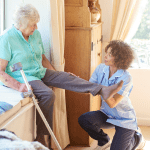
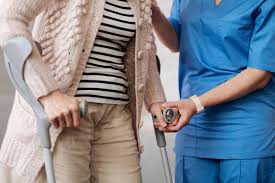
What would we do without caregivers? Not everyone is cut out to be a caregiver. It takes a special person to dedicate their time and energy to help another.  Caregivers provide help with daily essentials along with the physical and emotional support needed by our loved ones late in life. But do we ever stop to take care of the caregiver? How often do we say “thank you” for being there for our loved ones, our clients, and the most defenseless in society? When do we take the time to ask how the caregiver is doing? Care-giving can be a gratifying experience but can also cause a great deal of stress. While caring for and focusing on another, a caregiver can neglect their own health, causing harm over time. Therefore, it is essential to provide tools and resources to help manage stress. If a caregiver doesn’t care for themselves, they can’t care for someone else.
One way we can help is to spend a day honoring caregivers. On the third Friday of February, we can celebrate a group of people who selflessly provide support to our aging loved ones with patience and kindness. The Providers Association for Home Health & Hospice Agencies, PAHHHA, started National Caregiver Day in 2015 to recognize a profession that gives so much and often goes unappreciated. Caregivers spend time taking care of the essential needs of our vulnerable family members. A caregiver is anyone who provides help to another person in need and can be a family caregiver or a professional caregiver. According to the Mayo Clinic, 1 in 3 adults in the United States provides care as an informal caregiver to another adult.
 Make sure you take time on February 18th to honor the people who care for our most vulnerable population. For example, you could give cards with encouraging words of appreciation or a small gift to show gratitude. You can also honor caregivers on social media using the hashtag #nationalcaregiversday and let people know what makes them special. Here are some suggestions for a small gift to the caregivers in your life:
- Spa Gift Card
- Scented hand lotion or Candles
- Baked Goods
- Take them to lunch
You don’t have to spend a lot of money to show appreciation. Caregivers make a difference in the lives of others every single day so let’s take one day & make a difference in their lives. Pemi-Baker Hospice & Home Health offers FREE Caregiver support groups the first Wednesday of each month from 10-11:30am via Zoom. You will be able to connect with others, learn more about tools and resources to cope with the natural ebb and flow of your emotions and discuss any issues related to the monthly topic. Contact Guy Tillson to register at info@pbhha.org or call 603-536-2232.
With over 55 years of experience, serving clients from 29 towns in central and northern New Hampshire, Pemi-Baker Hospice & Home Health is committed to creating healthier communities. Services include at-home healthcare (VNA), hospice and palliative care, and Community Programs including: American Red Cross CPR/AED/FA, Caregiver Support Groups and Grief and Bereavement Support Groups. Providing compassionate care with experienced staff who are trained, certified professionals in the business because of their hearts. In your time of need, we’re right where you need us.
Pemi-Baker is located at 101 Boulder Point Drive, Suite 3, Plymouth, NH. To contact us please call: 603-536-2232 or email: info@pbhha.org Like our Facebook Page: @pemibakerhospicehomehealth
 Adults, young adults, and in some cases mature teens from all backgrounds, experiences, and cultures. Effective hospice volunteers embrace the fact that their role is one of compassionate service.
 Contact Shannon Cassidy, Pemi-Baker Hospice & Home Health’s Hospice Volunteer Coordinator at 603-536-2232 or email her at


 We will be making use of GRIEF ONE DAY AT A TIME by Alan D. Wolfelt, PhD. Dr. Wolfelt is a noted grief educator, having written several books about healing personal grief. His expertise derives from his compassionate interaction and caring service with mourners, listening to and reflecting on their responses to loss. He is the Founding Director of The Center for Loss and Life Transition in Fort Collins, Colorado. Although our group is offered for support rather than clinical intervention, the use of reading materials for the purpose of self-care and personal growth and healing is sometimes called bibliotherapy. The books will be made available at our first session of the group. We ask, if possible, for group members to make a donation toward defraying the cost of purchasing the books which group members will be able to keep for themselves. No one will be turned away if they are unable to make a donation.
 The book is THE 36-HOUR DAY: A Family Guide to Caring for People Who Have Alzheimer Disease, Other Dementias, and Memory Loss. The title itself, as does the book, pulls no punches. Providing ongoing care for a person with dementia is time-consuming, emotionally demanding, stressful, and exhausting, so that one’s days feel like they are longer than they are and packed with too much to do and remember.
 In this introductory section, there is a brief presentation raising the question “What Is Dementia?” The book is careful to explore all sides of the challenges of caring for someone with dementia. The authors really walk alongside the readers/caregivers in taking the first steps toward assuming the responsibility of caregiving. Having read the book, I am hard-pressed to discover any stone that has been left unturned. Let me be quick to say that not all dementia patients end up in nursing homes. Caregiving story endings vary from case to case, very much the result of the many factors both patients and caregivers bring to their own unique circumstances.


 Through Central NH RPHN COVID-19 response efforts, Angel has collaborated with partners across sectors in providing situational awareness, aiding partners in obtaining Personal Protective Equipment (PPE), standing up and demobilizing an Alternative Care Site (ACS), coordinating and operating mobile vaccine clinics addressing inequities, securing vaccine to meet Central NH RPHN needs and recently this partnership with PBCH to administer COVID-19 vaccine to homebound residents.